AI is no longer a decision organizations are making. It’s already embedded in how work gets done, whether or not leadership has addressed it directly. The question worth your attention isn’t whether AI matters. It’s which developments actually touch your organization, and what to do about each one specifically. Here’s what’s crystallizing for the technology leaders I talk to every week.
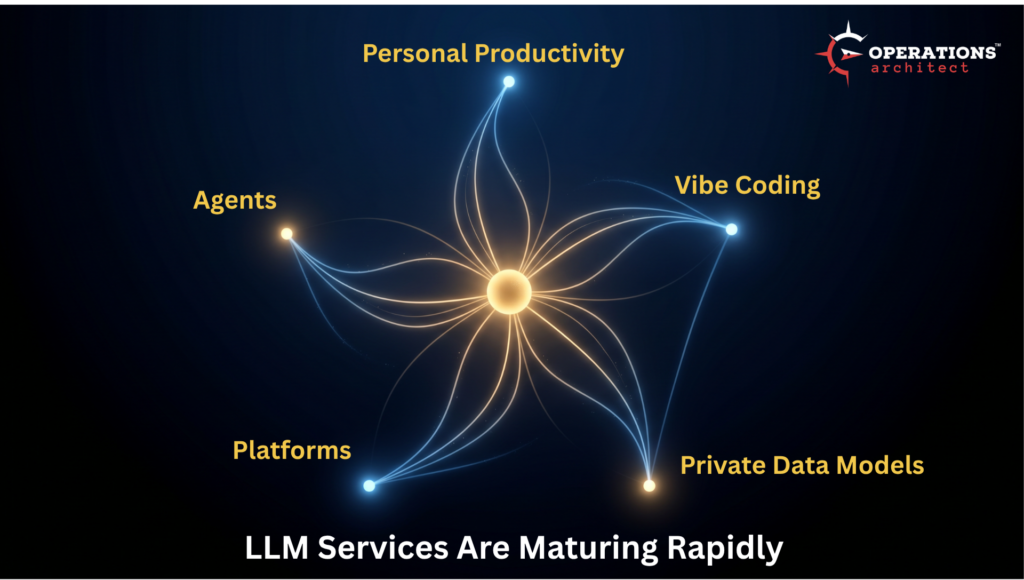
Boosting your Personal Productivity
The basic interaction, typing a request into a chat interface and receiving a substantive response, is genuinely useful for knowledge work. Not a list of links. A draft, an analysis, a structured document, a slide deck framework. Used well, it compresses hours of work into minutes.
Used without discipline, it generates confident-sounding nonsense at the same speed.
A chat interface that returns a substantive response, a draft, an analysis, a structured document, a slide deck framework, compresses hours of work into minutes. Used without discipline, it generates confident-sounding nonsense at the same speed.
Two practices make the difference. Establish the rules before you start: audience, purpose, voice, sourcing requirements, format. And require the model to flag its own confidence, a three-level classification on every analytical response:
- Confirmed — drawn directly from a named source.
- Inferred — derived from sources but not explicitly stated.
- Speculated — the model’s best estimate based on training, not a specific source.
That one requirement cuts hallucinations significantly and tells you exactly how much to trust each part of the response.
Agents: from task to process
Agents now execute multi-step workflows autonomously: given a goal, access to tools, and decision-making within defined parameters, they work through a process without a human managing each step. Individually, agents complete discrete tasks. In coordinated configurations, multiple agents run parallel analyses, synthesize outputs, and produce curated results, increasingly as operational infrastructure inside large enterprises, moving from task completion toward process ownership.
Human judgment remains essential; the question is where it sits. Human-in-the-loop, a person reviews and validates before results are acted on, is the honest default for anything consequential. Human-over-the-loop, where a person monitors trends rather than validating every output, is earned only by demonstrated reliability in stable, well-defined processes. The shift between the two requires evidence, not assumed confidence.
Building your own: real but not free
Tools like Lovable, Claude, and others have made it possible for non-engineers to build functional applications and agents through natural language. This is genuinely significant for smaller organizations that cannot afford custom software development.
Two caveats worth naming plainly:
First, building through natural language without understanding the underlying code produces applications that work until they do not. Diagnosing what went wrong requires expertise you may not have in-house. If your organization already has someone, a data engineer, a technical hire, an ML-adjacent role, who can explain why a model’s output is wrong, you have the expertise this requires. If the honest answer is that you would have to hire for a role that does not exist yet on your team, that is the signal that this caution applies to you directly. Anything running at production scale or handling consequential data deserves expert review before deployment. That review should produce a record: what was tested, what passed, and what didn’t. Without it, you are trusting memory instead of evidence the next time something breaks.
Second, while you avoid software development costs, you do incur ongoing costs per use. Those costs have fallen significantly and continue to fall, but for high-volume applications they are not zero.
What platforms are already doing
The major enterprise platforms have embedded AI in ways that produce results without requiring organizations to build anything custom. Identifying high-quality sales leads from large datasets, matching candidates to roles, monitoring supply chain signals, surfacing anomalies in financial data.
These capabilities are most valuable when the underlying data is clean and the person reviewing results understands the domain well enough to catch errors. Whether those capabilities are actually available to you often depends on how they’re deployed: some are built directly into your existing infrastructure, and others depend on third-party (3PL) stack integrations you don’t control. Ask which one you’re getting before you assume the capability is already yours.
Private data, private models
Organizations that need AI to operate on proprietary internal data, without that data leaving their environment, are deploying what are broadly called enterprise AI architectures. The most common approach is Retrieval Augmented Generation, or RAG: the model is connected to internal documents, databases, and systems, and retrieves relevant context before generating a response. The result is an AI that answers questions about your organization specifically, rather than the world generally.
RAG does not, by itself, keep that data private. It tells the model where to look. It does not tell the model where the output is allowed to go, or who is allowed to see it. Permissions and access controls have to be designed into the system from the start, not assumed as a byproduct of the architecture.
This is still early and requires meaningful investment to do well. The organizations getting value from it are the ones that treated their data infrastructure seriously before the AI layer arrived. If your data is messy, inconsistent, or siloed, the AI will faithfully reflect that.
The question your leadership team should be asking
Most conversations about AI focus on the technology. The more pressing question for your leadership team is structural: which roles in your organization are being automated, which are being augmented, and which are being redefined entirely?
The honest answer varies by function and by how well the work can be specified. Roles that involve synthesizing information, drafting communications, analyzing structured data, and managing routine workflows are being compressed. Roles that involve judgment under uncertainty, relationship management, and navigating genuinely novel situations are being augmented rather than replaced, at least for now.
Many leaders are finding it more useful to stop asking which roles survive, and start asking which outcomes need to be delivered, then staffing against outcomes rather than titles. Both lenses matter: the outcome lens tells you what to build toward. The role lens tells you who is affected by the transition, and how to talk with them about it honestly.
AI does not resolve a poorly designed operating model. It accelerates it, in whichever direction it was already heading.
That is where the series we are returning to next week becomes directly relevant. Now that we’ve completed the discipline arc and taken a couple of detours, we will now tackle Coherence: the organizational condition in which strategy, structure, and execution pull in the same direction, matters more, not less, when AI is accelerating the pace at which misalignment compounds.
Sarah Marshall is the Founder and CEO of Operations Architect and author of The Operating Edge: Building an Organization that Thrives in Disruption.
With thanks to T.J. Williams, whose questions during review directly shaped this article’s treatment of expertise requirements, data privacy in RAG architectures, and how to frame automation’s impact on roles.
Subscribe to The Operating Edge newsletter for weekly research-grounded content on building organizations that deliver.
Schedule an Introduction: https://calendly.com/sarah-marshall-operations-architect/30min
Self-assess your Organization: https://golden-kringle-96160c.netlify.app/
ADDITIONAL READING
On agentic AI and organizational readiness:
Agentic AI: The Change Your Organization Can’t Absorb for You — Sarah Marshall, The Operating Edge, 2026.
https://medium.com/@sarah.l.p.marshall
On AI and the future of work:
McKinsey & Company, A New Operating Model for a New World, 2025.
#GenerativeAI #AIStrategy #OrganizationalDesign #FutureOfWork #AILeadership #TheOperatingEdge #OperationsArchitect #LLM #AgenticAI #DigitalTransformation